





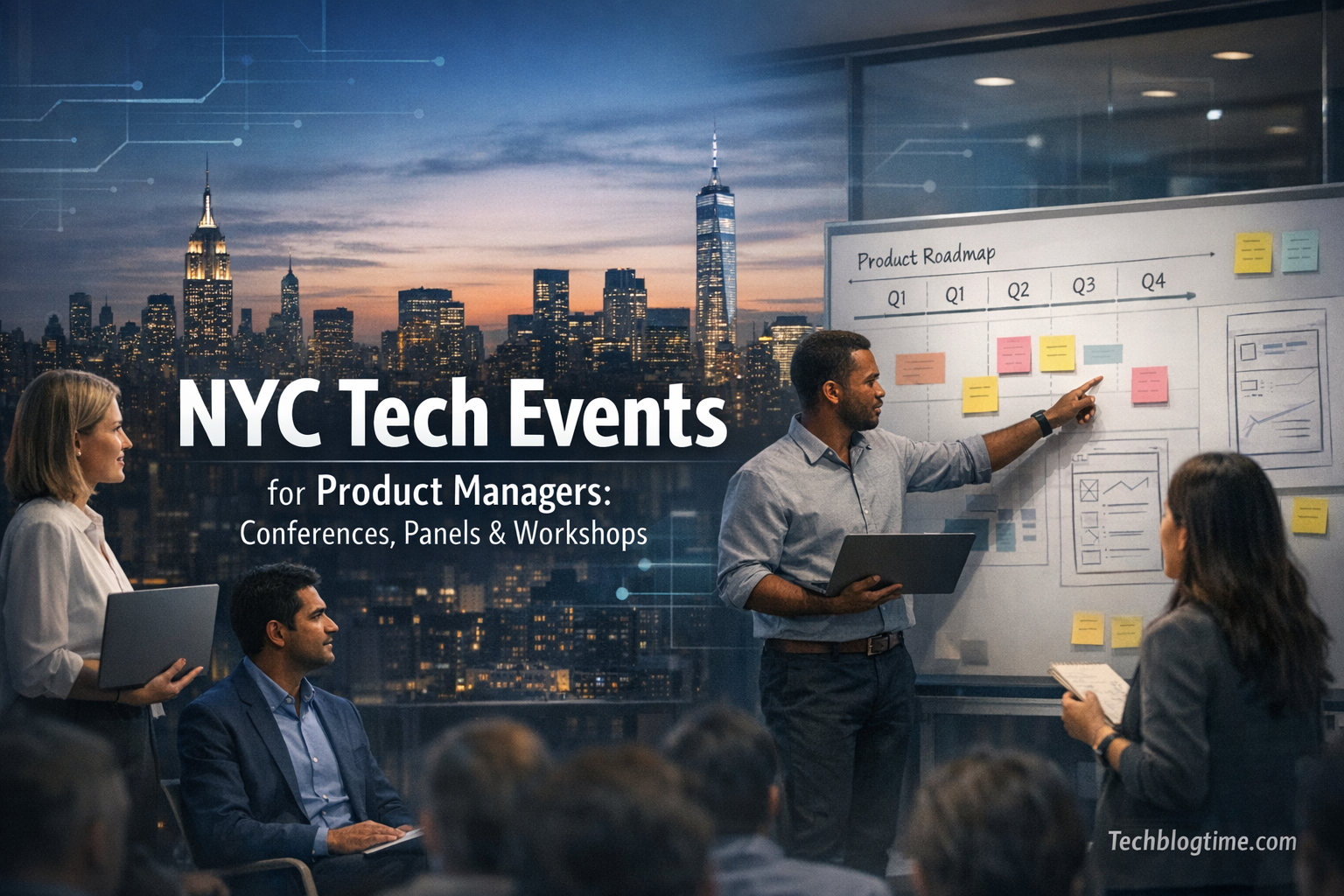
New York City is one of the few places where product management feels less like a job title and more like a living ecosystem. On any given week, you can walk into a room full of PMs shipping fintech features for millions of users, founders testing early product-market fit, researchers debating AI safety, and design leaders refining discovery practices—often within a few subway stops of each other. That density creates an unusually high “learning-per-hour” opportunity, and it’s the main reason NYC Tech Events matter so much for product managers. The city’s events scene is not just about networking; it’s a practical extension of the PM craft: discovery, strategy, experimentation, stakeholder management, and execution under constraints.
This guide is built for working product managers, aspiring PMs, and PM leaders who want to use NYC Tech Events deliberately. Not “attend everything,” but attend the right things at the right time, based on your product domain, career stage, and skills gap. We’ll break down how conferences, panels, and workshops differ in value, how to choose what’s worth your attention, and how to turn a two-hour event into compounding career returns.
Why NYC Tech Events are a serious advantage for product managers
The most valuable part of product management is rarely the frameworks—it’s the context. You can read about prioritization, but it’s different hearing how a PM at a high-growth marketplace handles supply-and-demand shocks in real time. You can study stakeholder management, but it lands differently when you listen to a product leader explain how they navigated a board-level strategy reset. NYC Tech Events are powerful because NYC concentrates industries that are deeply product-driven: fintech, media, e-commerce, adtech, health tech, B2B SaaS, cybersecurity, and enterprise infrastructure. That mix means you’re not limited to one “product culture.” You can learn discovery from consumer teams, analytics rigor from fintech, reliability from infrastructure, and pricing strategy from B2B—all without leaving the city.
Another advantage is speed. In smaller markets, career growth can feel like it requires changing companies. In NYC, you can grow by expanding your network, exposure, and skills without immediately switching roles. Attending the right events can introduce you to mentors, future teammates, or hiring managers—and just as importantly, it can give you language and insight that show up in interviews, stakeholder meetings, and roadmap decisions. Product is a craft built on judgment, and judgment improves fastest when you see many real examples. A thoughtful approach to NYC Tech Events is essentially a shortcut to broader product judgment.
Conferences: when big stages are worth your time
Conferences can be expensive, noisy, and overwhelming—yet they can also deliver a year’s worth of perspective in two days if you choose wisely. The best conferences for PMs typically offer three things: (1) structured learning tracks (strategy, discovery, growth, AI, leadership), (2) high-quality speakers who share real constraints and measurable outcomes, and (3) enough peer density that networking is not awkward—it’s natural. For product managers, conferences shine when you need to zoom out: understanding macro shifts (AI adoption, regulation, platform changes), learning what “good” looks like across companies, and building relationships beyond your immediate network.
To make conferences worth it, treat them as an investment, not an outing. Before you attend, identify a clear outcome: “I want a stronger approach to discovery interviews,” or “I need better methods for aligning stakeholders around prioritization,” or “I’m moving into a PM lead role and need to improve coaching and team rituals.” Then build a “session map” that supports that outcome—prioritize talks, roundtables, and networking blocks that are tightly linked to your goal. If you attend a conference with no intention, it becomes content consumption. If you attend with a focused problem, it becomes product research—except the users are other PMs and leaders who have already tested what you’re trying to learn.
Panels: where the real trade-offs finally get discussed
Panels are underrated for PM growth because they often reveal the messy truth behind product decisions. A single panel can surface contradictions that a polished keynote avoids: shipping fast vs. shipping reliably, customer requests vs. strategy, metrics vs. mission, experimentation vs. brand, AI opportunity vs. privacy risk. The best panels don’t just celebrate outcomes; they expose decision-making under pressure—what data they trusted, what assumptions failed, and which trade-offs they would repeat.
For product managers in NYC, panels are especially useful because many are domain-specific: fintech PMs discussing risk and compliance, media PMs debating subscription vs. ads, health tech PMs navigating regulation, or B2B leaders explaining enterprise procurement realities. When you attend these discussions, listen for patterns: how they define success metrics, how they coordinate with legal and compliance, how they handle stakeholder conflicts, and how they time product bets. Afterward, capture the “decision logic” rather than the “advice.” Advice is general; decision logic is reusable. That’s how NYC Tech Events become a practical tool: they give you mental models you can apply when your roadmap hits a similar constraint.
Workshops: the fastest path to skill improvement
If you want direct skill growth, workshops are often the highest ROI format in the NYC Tech Events ecosystem. A good workshop forces you to practice—writing a better PRD, running a discovery interview, designing an experiment, building a prioritization model, crafting a narrative for stakeholders, or mapping customer journeys. Workshops are valuable because they compress feedback loops. Instead of “learning” for weeks and applying later, you test your understanding immediately. This is how skills become instincts.
The trick is choosing workshops that match your current level and your immediate needs. Early-career PMs often benefit from workshops on fundamentals: product discovery, user interviews, writing clear requirements, setting success metrics, and communicating decisions. Mid-level PMs typically get more from advanced practice: experimentation design, pricing and packaging, platform strategy, cross-functional leadership, and roadmap negotiation. PM leaders benefit from workshops that focus on scaling product systems: hiring, coaching, operating rhythms, portfolio strategy, org design, and product culture. The best workshop question to ask yourself is: “What do I need to do better in the next 30 days?” If you can answer that, you can choose workshops that deliver immediate professional impact.
Meetups and community nights: consistent learning without the price tag
Not every PM needs conferences to grow. Often, the most sustainable and accessible path is the steady rhythm of meetups. NYC’s product community is large enough that you can find regular gatherings around nearly every niche: product analytics, growth, AI product, B2B SaaS, consumer apps, UX research, fintech, creator economy, and more. The value of meetups is consistency. You don’t need a once-a-year breakthrough if you have weekly exposure to new ideas and people who challenge how you think.
Meetups also create “weak-tie” networks—connections that aren’t close friends but become extremely valuable over time. A casual conversation at a meetup can later become a referral, a mentorship relationship, a speaking opportunity, or a collaborative side project. For PMs, these networks matter because product roles often require trust: hiring managers want confidence that you can think clearly, communicate, and lead across functions. A strong presence at NYC Tech Events builds that trust naturally, because people see you show up, ask smart questions, and contribute thoughtfully.
How to choose the right NYC Tech Events for your PM goals
The biggest mistake PMs make is attending events based on hype. The smarter approach is to match events to your goal and your product context. Start by classifying your current “PM growth focus” into one of four buckets: (1) execution and delivery (shipping reliably, writing better specs, clarifying requirements), (2) discovery and strategy (problem selection, customer insights, roadmap logic), (3) growth and metrics (activation, retention, experiments, funnels), or (4) leadership and influence (stakeholder management, storytelling, coaching, org design). Then choose events that align.
Next, evaluate the quality signals. High-quality NYC Tech Events tend to have clear agendas, credible speakers with relevant experience, and a format that encourages interaction rather than passive consumption. Look for events that include Q&A, roundtables, breakouts, or networking prompts—these features increase learning and relationship-building. Also consider the audience: if the event attracts people working on similar product problems, your conversations will be more valuable. If it’s too broad, you’ll hear generalized advice. Broad events can still be useful, but domain-relevant events often produce more actionable insights per hour.
A practical networking approach that doesn’t feel forced
Networking is often framed as collecting contacts, but for product managers, it’s better understood as building a learning network. Your goal is not to meet everyone—it’s to meet a few people whose thinking improves yours. At NYC Tech Events, the simplest approach is to arrive with two prepared conversation starters: one about your current product challenge and one about what you’re trying to learn. For example: “I’m working on improving activation in a B2B product—how do you typically define activation?” or “I’m trying to get better at discovery; what’s a question you ask in interviews that consistently surprises you?” These questions invite real discussion rather than small talk.
After the event, follow up with intent. A short message that references a specific point from the conversation and offers something useful—an article, a framework, a tool, a relevant intro—builds a relationship faster than generic “Great meeting you!” notes. Product is a collaborative craft; most PMs respond well when you share practical value. Over time, these small interactions become a professional network that supports career moves, mentorship, and deeper learning. If you attend NYC Tech Events consistently and follow up thoughtfully, your network will grow without feeling transactional.
Turning event learnings into real product outcomes
Attending events is easy; applying what you learn is where most people fail. The key is to treat every event like a mini-product research session. Capture notes in three categories: (1) one idea you can test immediately, (2) one framework that changes how you think, and (3) one person you should reconnect with. Then schedule a 30-minute “implementation block” within 48 hours. Use that time to translate one insight into action: adjust a metric definition, rewrite a discovery script, refine a roadmap narrative, redesign an experiment, or propose a small process improvement to your team.
You can also create a lightweight “event knowledge system.” Keep a running document where each event becomes a short entry: what you learned, what you applied, and what outcome it produced. Over months, this becomes a personal playbook—your own set of tested product principles rooted in real-world examples. This is why NYC Tech Events can be such a career accelerator: you’re not just collecting information; you’re building a system that compounds learning into results.
Budgeting and getting your company to sponsor attendance
Many product managers assume event budgets are fixed or unavailable, but companies often support attendance if you make the value obvious. The easiest way is to connect the event to a business outcome: “This workshop will improve our discovery process,” or “This conference track on pricing will support our upcoming packaging changes,” or “This panel series on AI governance relates to our compliance requirements.” When you frame an event as a targeted professional development investment, you make it easier for a manager to approve.
If cost is an issue, balance paid conferences with free or low-cost meetups and community events. NYC offers plenty of learning without high ticket prices, especially through evening panels, community nights, and sponsor-backed sessions. You can also propose a trade: “I’ll attend, then share a structured internal recap for the team.” That turns a single ticket into a multiplier benefit for the organization. Done consistently, this approach makes you known as someone who brings back useful knowledge—another way NYC Tech Events support your influence and leadership growth.
Building your personal NYC Tech Events roadmap for the next 90 days
The most effective way to use NYC Tech Events is to plan in short cycles. A 90-day roadmap keeps your effort realistic and aligned with your current role. Pick one major learning goal for the quarter—say, improving discovery, becoming stronger in growth, or stepping into leadership. Then choose (1) one deep investment event (a workshop or a high-quality conference), (2) two to four panels that match your domain, and (3) a recurring meetup cadence (for example, twice per month). This blend gives you depth (workshop), perspective (panels), and consistency (meetups).
Make it measurable. Decide what “success” looks like: “I will run five higher-quality discovery interviews using an improved script,” or “I will design two experiments with clearer hypotheses and success metrics,” or “I will lead one roadmap alignment session using a stronger narrative.” When you connect events to measurable behavior changes, you turn attendance into performance improvement. Over time, your event roadmap becomes part of your product operating system—an intentional loop of learn → apply → reflect → improve.