




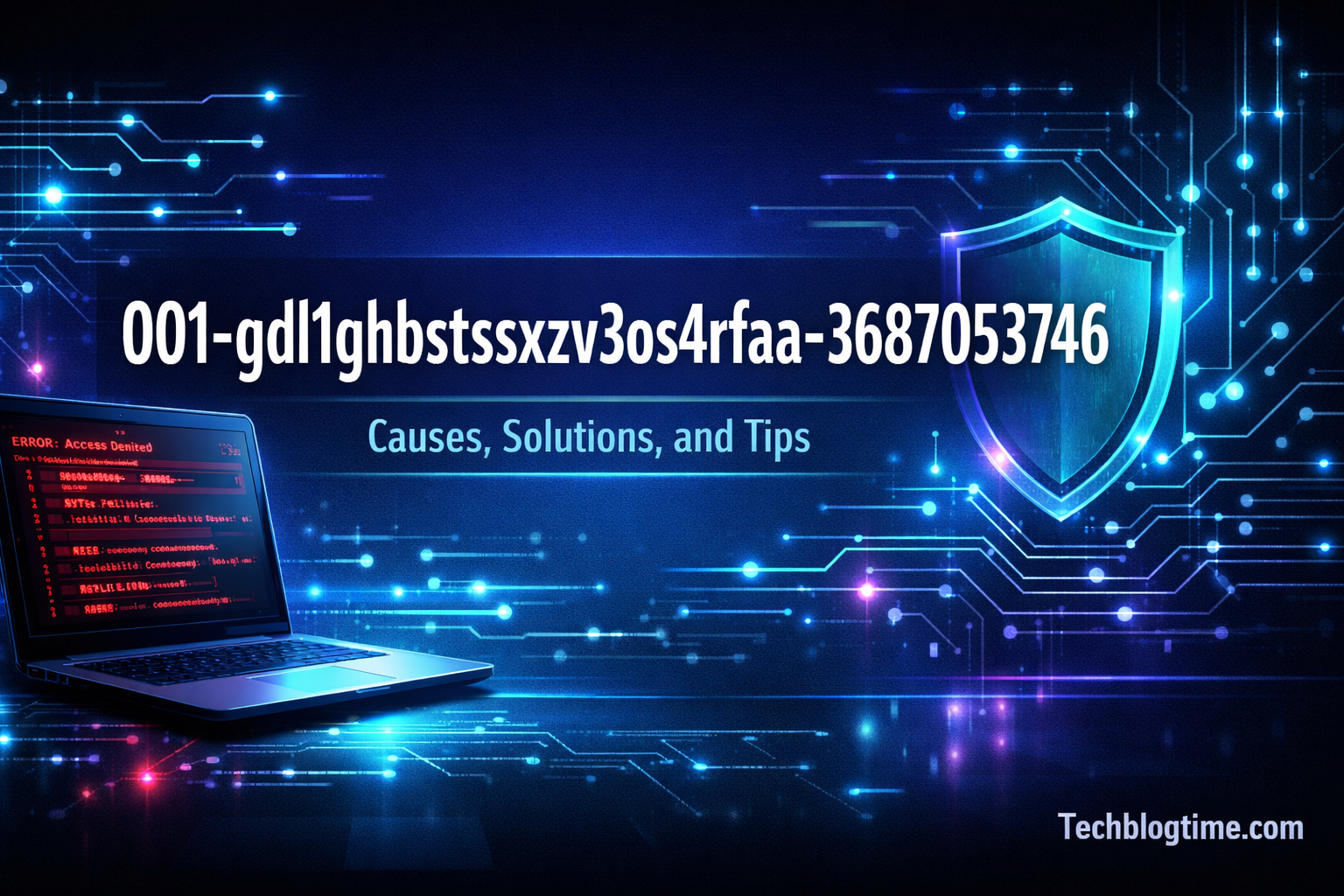
In the digital world, it’s not unusual to run into strange-looking strings of letters, numbers, and symbols—especially when you’re dealing with software logs, system errors, background services, database entries, or cloud platforms. One such mysterious keyword that has been appearing for many users is “001-gdl1ghbstssxzv3os4rfaa-3687053746”. At first glance, it looks like a random code, but for people who see it repeatedly in error screens, file names, device logs, app crashes, or account activity, it can raise real concerns.
So what exactly is 001-gdl1ghbstssxzv3os4rfaa-3687053746? Is it harmful? Is it a bug? Is it a tracking ID or system identifier? And most importantly—how do you fix issues tied to it?
This guide breaks it down in a human-friendly way. We’ll explore what it could represent, why you might be seeing it, the most likely causes, and practical solutions to get rid of related problems. Whether you’re a general user, a website owner, a tech support agent, or someone troubleshooting your own system, this informative article will help you make sense of the keyword and respond with confidence.
What Is 001-gdl1ghbstssxzv3os4rfaa-3687053746?
The keyword 001-gdl1ghbstssxzv3os4rfaa-3687053746 appears to follow a structured ID format, typically used for internal tracking in software systems. It doesn’t resemble a normal file name, a standard product key, or a recognizable operating system component. Instead, it looks like an automatically generated reference string—something created by an application, server, or system process to label an event, session, object, or transaction.
Many modern systems use unique identifiers like this for important behind-the-scenes operations. These identifiers can be attached to:
- App crash reports
- User sessions
- Temporary objects
- Background process requests
- API interactions
- Installation packages
- Database records
- Cloud storage objects
- Analytics or telemetry logs
A code like this is often used so a system can track activity without exposing personal data. In other words, even though 001-gdl1ghbstssxzv3os4rfaa-3687053746 looks confusing, it may be completely harmless by itself—unless it’s appearing due to an error or malfunction.
The problem begins when it pops up unexpectedly in a place where a user shouldn’t see it: an error message, a weird file, a blocked download, a corrupted folder name, or a failed login. When that happens, it usually indicates a glitch in how the system is labeling or loading data.
Why Is This Keyword Showing Up? Common Scenarios
If you’re noticing 001-gdl1ghbstssxzv3os4rfaa-3687053746 on your screen or in your system logs, you’re not alone. These kinds of strings appear in different environments and can be triggered for a variety of reasons. The key point is that the keyword itself may not be the true issue—it could simply be a clue pointing to a deeper problem.
Here are the most common scenarios where users run into a string like this:
- App or software error messages: Some programs display internal IDs instead of user-friendly messages when they fail.
- File downloads or uploads: A cloud service may generate an ID for file processing, then accidentally show it to the user.
- System logs and background monitoring tools: Advanced users may find it inside logs related to network calls, authentication, or service errors.
- Browser storage and cookies: Some platforms store internal identifiers and may reveal them after cache issues.
- Account login issues: Authentication platforms sometimes create session IDs that can appear if login fails.
- Third-party integrations: Plugins and API-based tools often exchange identifiers between systems, especially in automation workflows.
In most cases, the appearance of 001-gdl1ghbstssxzv3os4rfaa-3687053746 is not a “virus name” or a known malware signature. Instead, it’s much more likely to be a session identifier, request token, or object code that should remain hidden—but surfaced due to a configuration error, bug, or display issue.
Main Causes Behind 001-gdl1ghbstssxzv3os4rfaa-3687053746 Issues
To fix the problem, you must first understand what might be causing it. While this keyword may show up across different tools or platforms, the root causes often fall into a few main categories. Think of it like this: the identifier is the “label,” but the real issue is why the system is showing the label in the first place.
One common cause is software bugs or incomplete updates. If a program recently updated and introduced changes in how it generates or handles internal IDs, it might accidentally output the identifier instead of a normal response. Another cause is corrupted application cache or temporary data, which can cause a system to fail when attempting to load user settings, session information, or required configuration files. If the system can’t interpret the cached data properly, it may display the internal code associated with that process.
A third major cause is server-side failures or API timeouts, especially in cloud-connected apps. If your software relies on a server response (for example, to load content), and the response fails, the application may fall back to showing raw identifiers. This happens frequently in services that use microservices and distributed architecture, where each request is tracked via unique IDs.
Also, some users experience this due to permission or authentication mismatches. If your account or system doesn’t have the correct permissions, a request may be rejected. Some systems assign an ID to that rejection event, which might show up as something like 001-gdl1ghbstssxzv3os4rfaa-3687053746. Additionally, browser-related issues such as blocked cookies, over-aggressive ad blockers, or security extensions may interfere with session identifiers.
In rare cases, the keyword could relate to malicious scripts or suspicious browser activity, but that is far less common. Most of the time, it’s simply a non-human-friendly debug string.
How to Diagnose the Problem the Right Way
Before jumping into solutions, it helps to diagnose the context where 001-gdl1ghbstssxzv3os4rfaa-3687053746 appears. The troubleshooting process becomes much easier once you identify whether the issue is related to your device, your app, or a remote platform.
Start by asking yourself these simple questions:
- Where do I see this keyword?
Is it inside an app, a website, a file name, or an error message? - When did it start happening?
Was it after an update, installation, account change, or system restart? - Does it happen on multiple devices?
If it happens everywhere, it could be account-related. If it happens on just one device, it could be local. - Does it happen on multiple networks?
Testing on mobile data vs. Wi-Fi can reveal if it’s network-level blocking. - Is it connected to a specific action?
For example: logging in, uploading a file, opening a menu, or launching a certain feature.
If possible, take a screenshot or copy the full error message where it appears. Sometimes the keyword is shown alongside other helpful details like “invalid request,” “access denied,” “resource not found,” or “unexpected error.” Those phrases can guide you toward the right fix.
Also, check whether the issue is temporary. Many cloud platforms suffer short outages, and identifiers appear when systems are unstable. If the keyword disappears after a short time, it might have been a service disruption rather than a local fault.
Solutions: Fixing 001-gdl1ghbstssxzv3os4rfaa-3687053746 Step by Step
Now let’s get into the practical solutions. The good news is that most problems related to 001-gdl1ghbstssxzv3os4rfaa-3687053746 can be resolved using standard troubleshooting methods. You don’t need to be a programmer to fix it, but you do need a systematic approach.
The first step is to restart the affected app or system. It sounds too simple, but many internal identifier errors happen because a process got stuck and needs a fresh session. Close the app completely—don’t just minimize it. On Windows, check Task Manager and end the process. On mobile devices, force stop it. Then reopen and test again.
Next, clear cache and temporary data. If the issue is happening in a browser, clear your browser cache, cookies, and site data. If it’s happening in a mobile app, clear the app cache (and if needed, clear storage). Corrupted cache often makes a system “remember” bad data and repeat the same error again and again. Clearing cache forces the system to rebuild clean settings and re-request data from the server.
If that doesn’t work, try logging out and logging back in. Internal session identifiers can become invalid when your login state is inconsistent. Logging out clears session tokens, while logging in again creates fresh ones. This is especially effective for cloud apps, online dashboards, and services that store session IDs.
Another powerful fix is updating the app, browser, or operating system. If the keyword appears due to a known bug, developers may have already released a patch. Check for updates in your app store or system update center. This is particularly important if the issue began right after a recent update—because the next patch may resolve it.
If the problem continues, reinstalling the application can help. Uninstalling removes broken components, and reinstalling rebuilds everything from scratch. Just remember to back up any important data first.
Finally, test your system in a clean environment. For websites, try Incognito Mode. For apps, try Safe Mode or a different user profile. If the issue disappears, it suggests a conflict with extensions, stored settings, or another program.
Advanced Fixes for Persistent Errors (Tech-Friendly)
If you’ve tried the basic fixes and 001-gdl1ghbstssxzv3os4rfaa-3687053746 still shows up, it’s time to use more advanced troubleshooting. This section is especially useful for IT support professionals, developers, and power users.
A good step is checking network security settings and DNS configurations. Some network setups block certain services or redirect traffic, causing errors that show internal identifiers. Switching to a public DNS (like Google DNS or Cloudflare) can fix unresolved API calls and prevent server requests from failing.
You can also inspect logs. On Windows, Event Viewer may show related application errors. On Android, logcat can provide deeper error context. On Linux systems, journalctl can help. If the keyword appears in log entries, it can be connected to a specific service call or system component.
Another fix is disabling extensions, especially browser extensions. Ad blockers, privacy tools, and script blockers can interfere with session tokens, which may trigger weird identifiers to appear. Temporarily disabling them helps confirm whether the issue is caused by blocking.
For developers or admins working with platforms, check server-side APIs and integration responses. If your site or app uses third-party services (authentication, payment processors, analytics), a failure in those services might produce internal identifiers that reach the frontend.
Also consider permissions and access control issues. If the request is denied, systems often return IDs for tracking. Make sure user roles, access policies, and authentication tokens are valid and not expired.
Tips to Prevent 001-gdl1ghbstssxzv3os4rfaa-3687053746 from Returning
Fixing the problem is great, but preventing it from happening again is even better. While you can’t control every system bug or server outage, you can reduce the chances of encountering these errors by following a few smart habits.
Keep your apps and devices updated regularly. Many strange identifier errors are the result of compatibility mismatches—such as using an outdated version of an app that no longer matches the server’s latest protocol. Updating prevents that mismatch from happening.
Avoid installing too many extensions or “system cleanup” utilities that modify browser behavior. Some tools over-aggressively clear cookies or block scripts, causing session tokens to break and internal IDs to show up as errors. If you must use security tools, whitelist trusted platforms.
Make sure your system clock and date are correct. This sounds minor, but authentication systems rely heavily on time-based tokens. If your device time is incorrect, your login sessions may fail and trigger odd identifier-based messages.
Also, don’t ignore repeated crashes. If the keyword appears repeatedly during software crashes, consider filing a bug report to the developer. Internal identifiers like 001-gdl1ghbstssxzv3os4rfaa-3687053746 can help developers locate the exact failure point. Reporting it may not only help you—it may help thousands of other users too.
Finally, maintain stable internet connectivity. Some issues are caused by partial requests failing due to unstable network connections. Switching between Wi-Fi and mobile data, resetting routers, or upgrading network drivers can prevent recurring problems.
Is 001-gdl1ghbstssxzv3os4rfaa-3687053746 Dangerous or a Virus?
This is one of the most common questions people ask after seeing a long unfamiliar code. The short answer is: in most cases, no—it is not dangerous. A string like 001-gdl1ghbstssxzv3os4rfaa-3687053746 looks like a system-generated identifier, not a malware name.
Viruses and malware typically have recognizable patterns in behavior rather than random ID codes. For example, malware may cause pop-ups, unauthorized logins, system slowdown, unknown programs running in the background, or suspicious network activity. An ID string alone isn’t enough evidence to label it dangerous.
However, you should still stay cautious. If the keyword appears alongside suspicious behavior—like forced redirects, browser hijacking, unknown downloads, or repeated login attempts—it’s a good idea to run a trusted antivirus scan and check installed programs. Also, review your browser extensions and remove anything unfamiliar.
If you’re working in an organization, alert your IT department so they can verify whether the identifier is part of legitimate system logs or something unexpected. It’s always better to investigate early than ignore warning signs.
Overall, treat the keyword as a technical clue, not a threat by default.
When to Contact Support or Escalate the Issue
Sometimes the issue can’t be solved only from your side. If the identifier is generated by a cloud platform or remote service, then your fixes are limited. In these cases, contacting support can save you time and frustration.
You should consider reaching out to support if:
- The keyword appears with a persistent “access denied” issue
- Your account cannot log in no matter what you try
- The error affects multiple devices and browsers
- The issue happens to many users in your organization
- You suspect server-side downtime or a broken integration
- Critical business processes are blocked (payments, uploads, dashboards)
When contacting support, provide helpful details such as the exact keyword (001-gdl1ghbstssxzv3os4rfaa-3687053746), screenshots, time of occurrence, your device type, and any error text around it. Many teams can search logs using that identifier and quickly find what happened.
In business environments, you may need to escalate to technical specialists or system administrators, especially if the keyword relates to authentication servers, API gateways, cloud storage, or application performance monitoring tools.
The faster you collect accurate information, the faster the problem gets resolved.
Final Thoughts: Turning Confusing Codes into Clear Solutions
Seeing a keyword like 001-gdl1ghbstssxzv3os4rfaa-3687053746 can feel confusing, frustrating, and even alarming at first—especially if it appears unexpectedly in the middle of an important task. But once you understand that it’s likely a system-generated identifier, the situation becomes much easier to handle.
In most cases, the keyword is not harmful. It is simply a clue that something failed behind the scenes—such as a session token error, cache corruption, server request failure, or permission mismatch. The best approach is to troubleshoot calmly and methodically: restart the app, clear cache, refresh the session, update your software, and test different environments.
If the problem persists, advanced fixes like network adjustments, extension checks, and system logs can reveal the real source. And if it’s clearly a service-side problem, contacting support with this identifier can help resolve the issue faster.
At the end of the day, mysterious IDs like 001-gdl1ghbstssxzv3os4rfaa-3687053746 are part of modern technology. They aren’t meant for human eyes—but when they appear, they provide a doorway into understanding what went wrong.